
THANK YOU FOR SUBSCRIBING


Logistics Tech Outlook Weekly Brief
Be first to read the latest tech news, Industry Leader's Insights, and CIO interviews of medium and large enterprises exclusively from Logistics Tech Outlook


Supply chains rarely struggle because data is missing. Challenges arise when too many variables interact for planners to evaluate outcomes with confidence. Inventory, sourcing, lead times and service commitments create constant tradeoffs across cost, cash and service, a tension Oii.ai helps enterprises navigate through patented probabilistic AI and digital twins modeling.
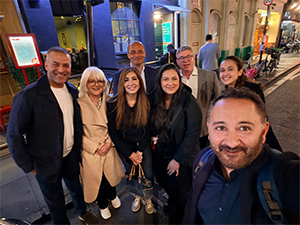 Positioned above planning platforms such as SAP, Kinaxis and o9, the platform functions as a decision intelligence turning operational data into scenario-based simulations and prescriptive Recommendation RTAs. A digital twin of the end-to-end supply chain allows organizations to test thousands of possible outcomes before committing to sourcing, inventory or network decisions. Decisions are made based on what is likely to happen, not assumptions.
“We take all the data from existing systems and turn it into an intelligence layer that allows companies to make decisions based on what will happen, not guesswork,” says CEO Uzair Bawany.
From Planning Data into Decision Intelligence
How does scenario-based supply chain modeling improve sourcing and inventory decision-making processes today?
Uncertainty is where the platform proves its value. Tariff changes, supplier shifts, distribution network changes and lead-time disruptions can all be modeled before decisions are made. A sourcing move from one geography to another can be assessed for impacts on inventory, lead-time variability and cost before execution. Similarly, distribution center consolidation decisions can be evaluated before physical changes are made. Scenario testing replaces assumptions with measurable tradeoffs, giving planners stronger control over service, working capital and operating cost.
Why is probabilistic modeling important for managing large-scale supply chain planning complexity effectively?
Complexity at scale makes that transparency critical. One retail use case involved more than 240,000 adjustable planning parameters, far beyond practical human management.
Probabilistic modeling identifies which levers matter, where parameter changes unlock value and how supply chains can be tuned more intelligently. Instead of managing every variable, planners can focus on the actions that drive the highest impact.
Proving Value before Transformation
In what way does proof-of-value testing support supply chain transformation and optimization initiatives?
The commercial model follows the same logic. A four-week proof-of-value exercise quantifies opportunities before broader deployment begins. Speed-to-value is central, with insights delivered within weeks rather than months. Clients receive a digital twin of their network, visibility into gains across cost, cash and service, and in some engagements identified opportunities to reduce inventory by as much as 30 percent while improving service levels.
Execution results have reinforced the model. One UK manufacturer operating seven ERP systems and five planning platforms used Oii.ai across 18,500 SKUs to expose excess buffers, refine reorder settings and surface sourcing tradeoffs that improved working capital and decision consistency. Hidden inefficiencies in reorder cadences and inventory policies became visible, allowing leadership to make better margin and service decisions.
“We are solving a very complex mathematical equation, but customers can see the workings,” says Bawany.
Scaling Optimization through Explainable AI
Patented probabilistic modeling remains the foundation, while agentic workflows, expanded optimization modules and API-driven automation continue broadening the platform’s reach. Monthly optimization cycles move planning closer to a continuously improving decision model. Automation allows recommendations to be applied directly into operational systems while still enabling user control and overrides. Supplier performance modules and expanded scenario capabilities continue to evolve, ensuring decisions remain responsive to changing supply chain conditions.
Greater value lies in helping organizations improve decisions before disruption forces reaction. Digital twins, probabilistic AI and transparent recommendations turn supply chain complexity into measurable planning action, positioning Oii.ai at the forefront of AI-powered supply chain planning.
Company
Oii.ai
Management
Uzair Bawany, CEO
Description
Oii.ai is a supply chain decision intelligence platform that uses digital twin technology and probabilistic AI to simulate outcomes before execution. It integrates data from existing systems to provide scenario-based insights, helping organizations optimize cost, service, and working capital while enabling faster, more informed, and scalable operational decision-making.